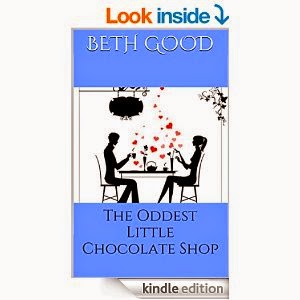
I recently published a romcom novella under the name Beth Good, written collaboratively with a writer I know personally from Romantic Novelists Association events, Viki Meadows. It was the first book I've written with another author, and Viki herself is quite a new author, so neither of us knew what to expect when we started. By the end though, I think we were both pleased with the result, and would happily recommend collaborative writing to others.
The idea came to me while watching a television interview with the hugely successful thriller writer, James Patterson. He has a great franchise with his novels, but found he simply couldn't keep up with demand. So he began working with other writers on stories he had originated, editing and shaping them into Patterson-style novels, with those writers getting credit on the cover - and no doubt having a fantastic experience working alongside Patterson himself.
I was in a similar position with my Beth Good romcoms. I have a good readership for them, a (largely UK) fanbase who buy all my romcoms under that name. But with contracts underway to write thrillers as well, and several other projects in hand, I simply couldn't manage to write as many Beth Good stories as I wanted. So I rather cheekily decided to try the James Patterson approach myself, and enlist the help of another writer to work on a novella I had already plotted out in detail from beginning to end.
That story became the delightful CHRISTMAS AT THE LUCKY PARROT GARDEN CENTRE, and I hope that it will be the first in a series of romcoms with this Yorkshire garden centre setting.

I had known Viki for some time through the RNA, and always thought her prose marvellously smooth and well-written. I'd edited her manuscripts before too, and we had communicated well. So she was a natural first choice for this project, and I was thrilled when she agreed to give it a try.
I started out by talking to Viki about the plot and the characters I'd devised. After all, she might have hated those elements, and that would have made writing our story even more of a challenge.
Luckily though, she loved them, and indeed ended up infusing them with a wonderfully natural colour and vivacity, not to mention striking verisimilitude, being Yorkshire-based like the heroine of the story.
After the success of her first chapter, we continued on like that, with me talking her through the plot in close detail - mainly to get the pace right - as she had never written such a long piece of fiction before, and then editing and consolidating at every stage. As the book grew, so did Viki's confidence, and it became a very enjoyable and easy-going process. After she had finished her part, I then shaped the novella, concentrating on pacing and tone initially, and then added my own contribution. It was vital that the book was recognisably a Beth Good romcom, that readers would sense that and enjoy it as much as any other Beth Good story. So that was my focus. But of course Viki's voice is very distinctive too, and that comes through in the writing.
Luckily though, she loved them, and indeed ended up infusing them with a wonderfully natural colour and vivacity, not to mention striking verisimilitude, being Yorkshire-based like the heroine of the story.
After the success of her first chapter, we continued on like that, with me talking her through the plot in close detail - mainly to get the pace right - as she had never written such a long piece of fiction before, and then editing and consolidating at every stage. As the book grew, so did Viki's confidence, and it became a very enjoyable and easy-going process. After she had finished her part, I then shaped the novella, concentrating on pacing and tone initially, and then added my own contribution. It was vital that the book was recognisably a Beth Good romcom, that readers would sense that and enjoy it as much as any other Beth Good story. So that was my focus. But of course Viki's voice is very distinctive too, and that comes through in the writing.
Overall, I thought this kind of collaborative effort was not only a wonderful way to mentor a new writer, but a learning process for me too. I learned a great deal about structure from having to explain it, and I was pleased that my reputation in certain quarters for being a prickly pain-in-the-butt did not seem to impinge on my working relationship with Viki!
Looking back, I consider our partnership to have been a brilliant success, and I certainly hope it won't be the last book I write collaboratively. Together we have ended up producing an exciting, fast-paced, and thoroughly entertaining romantic comedy that feels as much like a Viki Meadows story as a Beth Good!
Despite being busy with her own new writing, Viki Meadows has very kindly agreed to answer a few questions about the collaborative process too, and this is what she has to say ... (Viki's responses are in italics)
Can you describe how the collaboration process started for you, and your first steps when you began writing?
My collaboration with Beth Good/Jane Holland began when I was on a writing high. I'd just got a mark of 81 for an MA assignment when I was contacted by Beth asking if I'd be interested in working with her.
After the first excitement had worn off, I started thinking of what it would really mean. The plan was for me to work off her plot / outline and of course this raised all sorts of considerations and potential problems, but it was simply too good an opportunity to pass up, especially based on nebulous fears.
I said yes, and knuckled down (sort of) to try and do it. Because of my concerns, which included things like, would I be able to write to someone else's plot, could I write humour, would the author like my work, I asked if I could do a one-chapter trial, after which, if there were problems, we could both pull out with no hard feelings.
Once I started writing I quickly engaged with the story. At times it was a bit like a puzzle. Working out how to make something happen when it needed to required ingenuity and mental agility, and I particularly enjoyed it. Beth seemed pleased with my work, and that approval motivated me and kept me going. Working with such an easy-going person was great. I felt supported without having someone breathing down my neck. I think it was helpful that we are both quite laid back. If one of us had been more uptight it might have been more challenging to collaborate like this.
What was the most difficult part of collaborating for you, and why?I had all sorts of preconceived ideas and fears about my ability to complete the project, and so my biggest challenge was squishing those doubting voices. I also needed to be disciplined. It’s all too easy as a writer to slip into writing when you’re in the mood or feeling inspired. Even though I knew that wasn’t a good way to approach a writing career I’d never really developed a regular writing habit and for too long I’d been hit and miss. When Beth approached me about this collaboration, she took a risk on me, and I really didn’t want to let her or myself down. So I had to be professional and disciplined, and this was also a major challenge.
What do you think you've learnt from this that will be most useful to you in future?
That I CAN finish a project to an acceptable standard, that I can write MUCH faster than I thought, and therefore I now have NO excuse not to produce a lot more work.
I also learnt a lot from the way Beth took the raw material and turned it into a polished end product. The way she knew what to exploit and how to exploit it to make the story funnier and more focussed was fascinating and the mechanics of how she did that provided a real learning curve. I’ll certainly be trying to apply some of her techniques during rewrites on my own work.
Would you recommend collaboration to other writers?
Yes, for sure. I’ve mentioned some of the many benefits above but writing can be such a solitary thing to do and collaborating with another author made it more social and much more fun. There was a great feeling of satisfaction in creating something together rather than on my own, and a sense of companionship as well. I loved seeing the project take shape and how another author’s input could transform it in ways I hadn’t considered.
What are your writing plans for the future? Do you have a new story of your own lined up, for instance?
I’m feeling quite fired up and excited. I’m writing the first draft of a new novella and also trying to finish rewrites of a romantic suspense novella. Beth’s output and professional, disciplined approach to her writing is keeping me motivated and giving me something to aspire to. I’m also working on an MA in Creative Writing which takes up a fair bit of time but also helps keep me writing regularly.
***
Now, why not read the free sample on Amazon of
Christmas is coming to the Lucky Parrot Garden Centre near
Whitby. And along with those first flakes of snow comes a tall, dark,
and highly tempting stranger ...
Hannah is a sensible, hard-working Yorkshire lass, and her heart is set on a career in landscape gardening. Not on falling in love, not even with a man as drop-dead gorgeous as Daniel Elliott. He's a film producer, for goodness sake, more used to Hollywood parties than stomping about in muddy wellies.
But as the evenings draw in and the snow thickens, can Hannah resist the warmth and sparkle of this very unusual man? And if she can't, what's to say Daniel won't disappear every bit as mysteriously as he arrived?
The first in a brand-new series, this cosy, festive romcom is the fruit of a collaboration between popular author Beth Good and romance newbie Viki Meadows. Perfect for fans of Jane Linfoot, Jenny Colgan, and Milly Johnson.
Hannah is a sensible, hard-working Yorkshire lass, and her heart is set on a career in landscape gardening. Not on falling in love, not even with a man as drop-dead gorgeous as Daniel Elliott. He's a film producer, for goodness sake, more used to Hollywood parties than stomping about in muddy wellies.
But as the evenings draw in and the snow thickens, can Hannah resist the warmth and sparkle of this very unusual man? And if she can't, what's to say Daniel won't disappear every bit as mysteriously as he arrived?
The first in a brand-new series, this cosy, festive romcom is the fruit of a collaboration between popular author Beth Good and romance newbie Viki Meadows. Perfect for fans of Jane Linfoot, Jenny Colgan, and Milly Johnson.