 | |||
Novelists heading for the Pick 'n' Mix Ideas Counter at Woolies.
|
'Where do you get your ideas from?'
But on a serious note, where do we get our ideas from as novelists?
Novelists work in many different ways, so there are multiple answers to this question: historical accounts, snippets of conversation overheard on a bus, a clipping from the newspaper or something seen on a documentary, a real-life experience, a close friend's story, an unusual anecdote told in the pub or office, meandering thoughts jotted down in a notebook, then perhaps forgotten about for months or even years, until something else comes along to light the blue touchpaper ...
The word 'novel' means 'new', of course. It always reminds me of the old wedding day rhyme:
Something new
Something borrowed
Something blue
There is something in this simple piece of traditional advice we can take away as novelists and re-use for our own purposes. Something borrowed, in particular.
Novelists are the ultimate Borrowers. (Thank you, Mary Norton.) Writers were recycling and re-using long before it become an important and necessary habit to save the planet. Chaucer lifted his impressive 'Canterbury Tales' structure from Boccaccio's Decameron, and Shakespeare kept a much-thumbed copy of Holinshed's Chronicles under his straw mattress. (Or so I like to imagine.) But don't get me wrong; I don't consider these to be instances of lazy writing. Borrowing is as much about the way our brains work, leaping at a tangent from idea to idea, as it is about needing impetus for a new story. We can all agree, I'm sure, that Shakespeare was no slouch in the imagination department. Yet he constantly borrowed - a far nicer word than 'stole' - story ideas from history or other writers so he could keep writing at what must have felt like an insane pace, feeding the insatiable monster that was the Tudor taste for theatrical extravaganza.
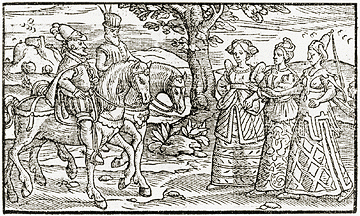 |
| Shakespeare's imagination was caught by the fantastical suggestion, noted in Holinshed's Chronicles, that Macbeth was influenced by witches. "Ching!" Into his basket it went. |
So borrowing an idea or two that's already been done can provide a shortcut to your own story idea, and even a shortcut to your own brain and the way it tells stories.
That's why we like some writers better than others. Some writers - however popular with others - may leave us cold. Others fire us with excitement. That's because we recognize something of ourselves in their work: the way they write, the way they see the world and tell their stories, connects to our own beliefs and identity on a deep level. We say, 'Yes!' when we read them, and feel they are speaking directly to our own experience. That mental click is what we reach for as writers when we begin to scratch about for a new novel plot.
This is not plagiarism, of course, which is something no self-respecting writer would do. You do not take work wholesale from other people. That would be theft and is against the law. Just saying.
Death by Stickies ...
Instead, you might keep an 'ideas' notebook on the go, plaster a wall with Stickies, scribble on a whiteboard in the kitchen, or pack your own 'teeming brain', as John Keats put it, with possibilities. Then, when you're ready to write a new story, you cherry-pick from this chaotic jumble of ideas and images, and put them together in a brand-new way: that pub conversation about the successful businessman who jumped to his death - and no one knows why - may fit neatly with that drama you saw on television the other night where the wife accidentally intercepted a blackmail letter, and maybe your own loose floorboard may give you the hiding-place for those incriminating photos.
So we cobble things together. Our own ideas, our own lives, a mishmash of things we've seen or heard or read or experienced. We tear things up in our mind and stick them together again in a new order. We recreate Dr. Frankenstein's monster each time we plan a new book. We may take something that existed in another form or universe, and breathe fresh life into it, make it new.
 |
| There's room for everyone's novel: even yours. |
And an idea may feel new to us. Flushed with the triumph of imagination over torpor, we tell ourselves a plot has come straight out of the ether, that it came clean and true and unrelated to anything else, that it owes nothing to anyone. But really?
At the heart of it, there is something a little bit shady about the idea-generating business. The novel idea. Because 'novel' does actually mean 'new', remember? And we have been told since antiquity - Ecclesiastes - that there is 'nothing new under the sun.' So finally we have to turn and face the dreaded word we have been trying to avoid all along.
Originality?
As novelists, we are always told to make it new, to be original. Agents clamour for it - to avoid selling the same old stories to jaded editors. Publishers demand it - to avoid being sued. Readers hope for it - to avoid being bored. And we ourselves - to avoid professional embarrassment, if for no other reason - hunt for originality like the Holy Grail, even when writing in a self-limiting field like series fiction. In fact, novelists being grandiose types, we want our latest idea to be the most original idea in the history of novel-writing. (And if we can't quite stretch to that, then we will reluctantly settle for the best idea we've come up with so far.)
But here's the thing. The truly novel idea is impossible. So just do what you can, and don't sweat it too much if another writer - or indeed several other writers - have books out the same month that echo yours. (This happens uncannily often.) Novel-writing has a lengthy and respectable tradition, and your novel is adding to that, like one of those chain poems where everyone contributes a line. You cannot be read out of context and so should not feel you need to write out of context.
What can be original and new in all this borrowing and cobbling is you. Your narrative voice. Your treatment. Your unique way of seeing things and putting them together. You are the magic ingredient that makes it new. So when you're stirring the pot, don't lose confidence because there are thousands of other blackmailed husband and betrayed wife stories out there. None of those stories are like yours because they were not written by you. (Hopefully! I'll deal with writers who repeat themselves or have 'favourite' themes in a later post.)
 |
| Question: where do you get your ideas from? Answers in the comment box, please. Join the debate! |
So yes, the idea for a novel is always impossible, because it is never simple, never original, and almost never turns out exactly as you intended at the planning stage. But just remember that your idea cannot be seen out of its context in the grand parade of novels that came before - and will come after - and that you yourself are the magic ingredient that makes your hotchpotch of characters and ideas into something novel, something new.


